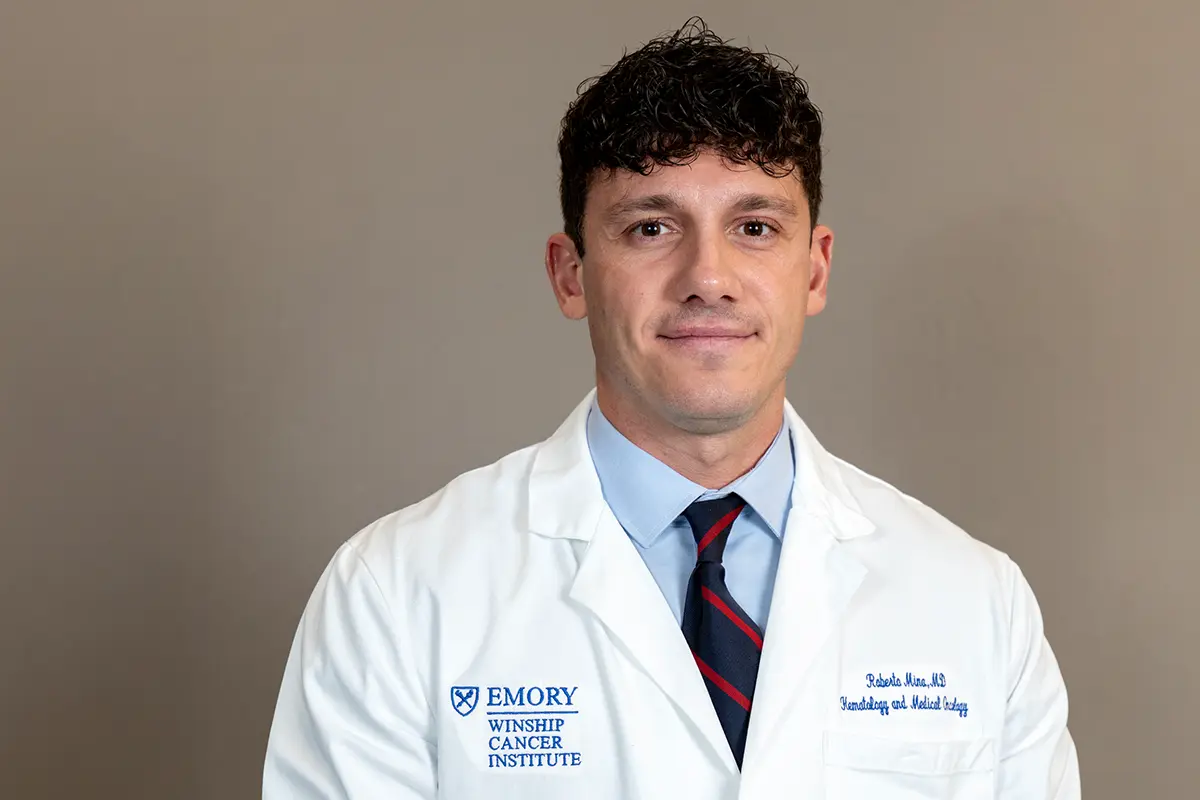
Roberto Mina, MD, is a hematologist with expertise in bone marrow transplantation and cellular therapies. He specializes in treating plasma cell disorders, including multiple myeloma, monoclonal gammopathies of undetermined significance (MGUS), amyloidosis and rare plasma cell dyscrasias such as plasma-cell leukemias and POEMS syndrome. Dr. Mina began practicing as an attending physician with Emory Healthcare in 2025.
He is an associate professor in the Department of Hematology and Medical Oncology at Emory University School of Medicine. Before joining Emory, he was on the faculty at the University of Turin in Italy.
Dr. Mina completed his medical education and hematology specialization at the University of Turin, followed by clinical and research fellowships in hematology. He also held a visiting scholarship at Winship Cancer Institute of Emory University in Atlanta.
His research focuses on plasma cell disorders, particularly multiple myeloma, including diagnosis, measurable residual disease (MRD) assessment and treatment of older patients. His work includes designing and implementing national and international clinical trials, especially early-phase studies, to explore novel agents, transplant strategies and advanced therapeutic sequencing.
Dr. Mina is a reviewer for journals such as Annals of Hematology and Neoplasma and has authored numerous peer-reviewed publications on multiple myeloma and plasma cell dyscrasias.
Titles & Roles
Associate Professor, Department of Hematology and Medical Oncology
R Mina, E Antonioli, G Barilà, N Bolli, C Botta, A Furlan, C Liberatore, M Martello, S Moré, S Oliva, B Rossini, E Saraci, AG Solimando, P Storti, E Zamagni
03/01/2026
Ratings & Reviews
Patients who are treated in outpatient and inpatient environments are eligible to receive a survey related to their individual care. Displayed ratings and reviews are displayed for Providers who have received at least 30 returned surveys over a 12-month period and are related to all Care Provider related survey questions. To help our patients better understand our Transparency program (ratings and review), the motivations behind it, how ratings are calculated, why ratings and reviews are not published for every EHC Provider, and how this information can be helpful for our patients, please click here.
I'm a physician myself - I've been very impressed with Dr. Mina.
One star
One star
One star
One star
One star
09/05/2026
I really enjoyed my visit. It far exceeded my expectations
One star
One star
One star
One star
One star
08/01/2026
I'm a 62 year old physician myself and I own a hospitalist group that employs multiple physicians and nurse practitioners. I already knew that Roberto Mina, MD was young and a relatively new staff member. I was thoroughly impressed with him and have nothing but positive things to say regarding my visit. I intend to continue my care with him and will be referring my own myeloma patients to him in the future.